What does your day look like?
Here is one way to answer. Read it aloud, then change the activities and times to fit your life. Three true sentences are a perfectly good start.
On weekdays, I get up at seven and have breakfast. Then I get dressed and leave home. I start work at nine and have lunch at twelve thirty. In the evening, I cook dinner and read for a while. I go to bed at ten thirty. On weekends, I get up later.
Borrow the shape of the answer, not someone else’s schedule.
From morning to night
Choose the phrases you need. With “I”, use the simple present for habits: “I have breakfast at seven.” Compare “I am having breakfast now” (happening now) and “I had breakfast at seven” (in the past).
These examples describe one person’s day. You can say “I study in the afternoon”, “I work at night”, or choose something else you actually do.
Morning
Getting ready for the day
- I wake up at six thirty, but I get up at six forty-five.
- I take a shower and get dressed.
- I have breakfast at seven.
- I leave home at eight and take the bus to work.
During the day
Work, study & getting home
- I start work at nine and have lunch at twelve thirty.
- I finish work at five and get home at six.
Evening
Winding down
- In the evening, I cook dinner and wash the dishes.
- After dinner, I read or watch a show.
- I brush my teeth and go to bed at ten thirty.
Add a time. Add a little detail.
A time helps your listener picture the day. Use “at” for clock times, “in” for parts of the day, and “on” for days. The exception is “at night”.
- A clock time
- at seven · at twelve thirtyI have lunch at twelve thirty.
- A part of the day
- in the morning · in the eveningI cook in the evening.
- A day
- on Mondays · on weekendsI work from home on Mondays.
Usually means on most occasions; sometimes means on some occasions. Put them before the action: “I usually have breakfast at seven.” With “be”, put them after it: “I am usually tired in the evening.” “Skip breakfast” means not have breakfast.
“On weekends” is common in American English. In British English, you may also hear “at weekends”.
- I usually have breakfast at seven.
- I sometimes skip breakfast.
- I work from home on Mondays.
- On weekends, I get up later.
Turn an answer into a conversation
Sam and Alex are chatting during a break. “What time…?” asks for a time; “What do you do…?” asks about an activity. Use “What about you?” or “How about you?” to invite the other person to answer too.
Morning, Alex! What is your daily routine like?
I usually get up at seven and have breakfast. Then I take the bus to work.
What time do you start work?
At nine. What about you?
I work from home, so I start at eight. What do you do in the evening?
I cook dinner, then I read or watch a show.
Do you always follow the same routine?
Do you mean on weekdays or on weekends?
On weekends.
No, I get up later on weekends. How about you?
Me too. I like a slow morning. Enjoy the rest of your day!
You too!
Read both parts once. Then cover Alex’s answers and try your own.
You do not need a perfect answer
If you are not sure which days someone means, ask “Do you mean on weekdays or on weekends?” If they spoke too fast, ask “Sorry, could you say that more slowly?” These solve different problems.
An irregular schedule is fine. “My routine changes from day to day” explains it. “Around nine” means approximately nine. Pause, then give one real detail.
- Do you mean on weekdays or on weekends?
- Sorry, could you say that more slowly?
- Let me think. My routine changes from day to day.
- I do not have a fixed start time.
- Most days, I start around nine, but sometimes I start later.
Speak in small, clear groups
Try: “On weekdays / I get up at seven / and have breakfast.” Pause at the slashes; do not say them aloud. Use “then” to move to the next activity and “finally” for the last one, without adding a linking word to every sentence.
Say “six thirty” and “six forty-five” slowly, then put them back into a sentence. If you catch yourself saying “I am get up”, try “I get up” for a habit. Clarity matters more than speed.
Make it your day, in seven minutes
0 of 4 steps completed
Check what you remember, then say it without choices
The lesson gave you the language. Use three short questions to retrieve it, review any weak answer, and then continue the same situation as an open conversation with Sophia.
Useful first pass. Review and try again.
0/3The missed answers show exactly what to revisit before the open conversation.
Review before you retry
Your day. Your next conversation.
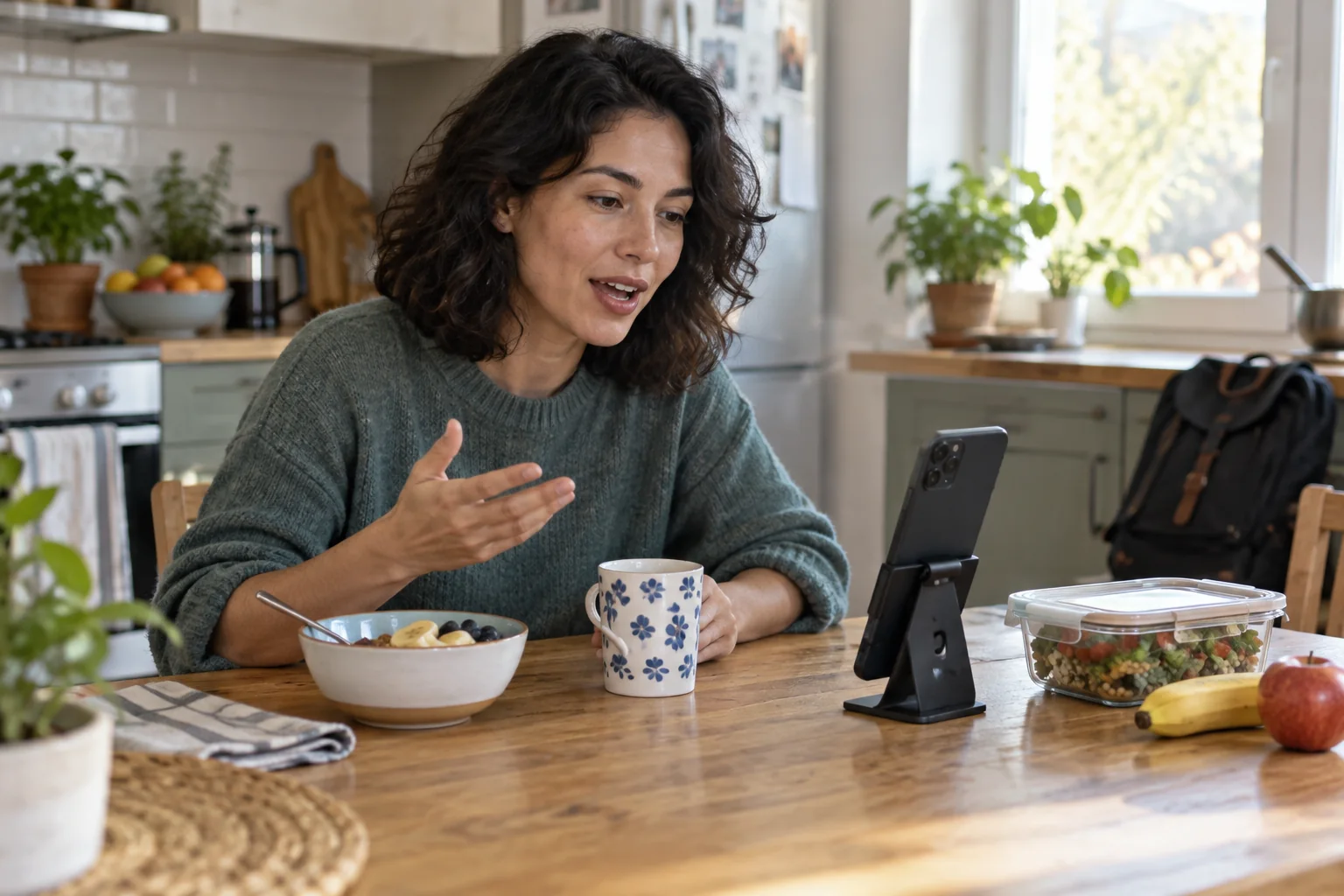
Talk about your own day with Sophia, a friendly AI tutor in SpeakAvatar. Start when it suits you, get immediate feedback, and try again at your own pace — without booking a lesson.
I want to practise describing my daily routine in English. Ask me about my morning, afternoon and evening, one question at a time. Help me with the simple present and times. Ask about weekends, explain corrections patiently, and let me try again.
Copy this goal and add it as your custom learning goal in the app. It is not transferred automatically. The lesson and quiz stay free to read on any device.
Choose App Store for iPhone or Google Play for Android.
Back to the lesson ↑